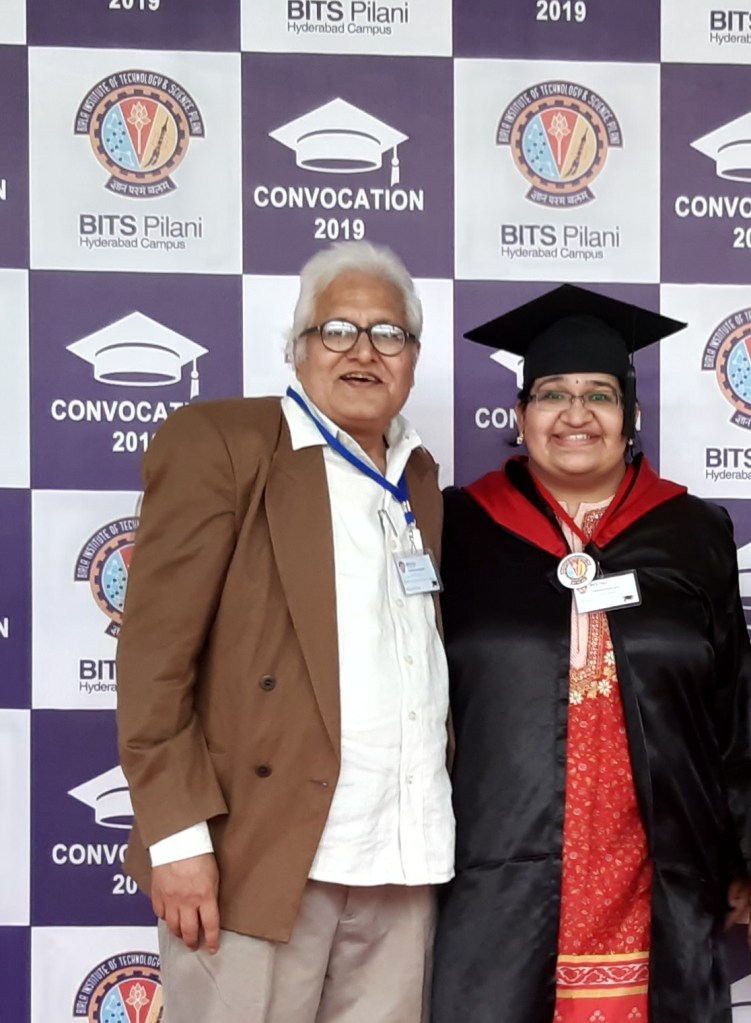
In this picture, I am 21 years of age – and in my first semester of Master’s. As you can clearly see, it is from Undergrad graduation day. The man on my left… is my father. He passed away on the 10th of December 2025 after a prolonged illness that lasted for 3 months. My lack of updates was because I was spending whatever time I could with him in the hospital… while anticipating grief. The doctors had told us in October – “Prepare yourselves”. Knowing that it will happen and it happening? Both are completely different beasts. As an only child, I did not have a favorite parent. The psychology of only children who are brought up in a loving environment… is different. There are some things you share with your Dad. And some things that you share with your Mom. And both nurture a different part within you to make who you become. It is not an exaggeration for me to say that I am who I am because of the two people who gave me life. I grew up seeing my Mom and Dad read. I saw my Mom dance to tunes in the kitchen. I saw my Dad laugh to British comedies. I saw my Mom paint landscapes on canvas. Neither asked me to be like them… but I did absorb some of their traits. And brought in my own – to become Srividya Bhagavatula. Loss of a parent in your twenties… is weird. You are at a stage where you are not dependent, but you still need their guidance. And right now, half that guidance… is lost. At a crucial stage. As an unmarried daughter, my dad will never see me walk down the aisle. Hell, I have not fallen in love yet… to even make it there. He and I shared love for classic movies and books and laughed about them. Now, that is also gone. He inspired me to want to teach… and I always said “Your trainees loved you. I need pointers” Now I will never get those pointers. What is left are… memories and laughter… and that pain that I know will always be there… but will only dull with time as I learn to live without his presence.
My interest in biomedical research in oncology began with intellectual curiosity but deepened through a personal encounter with physiological dysfunction that remained unrecognized for years. From 2017 through the end of my undergraduate studies in 2019, I experienced severe menorrhagia, chronic fatigue, unnatural weight gain, and debilitating headaches that steadily eroded my stamina and cognitive clarity. Medical consultations repeatedly concluded with broad assumptions that are common amongst gynaecologists in India who rely on limited tools available to diagnose “unmarried women” – PCOS, weight-related issues, or possible endometriosis. These explanations never accounted for the intensity of my symptoms, yet without further investigation, they became the default narrative combined with unfortunate and dismissive remarks, OCPs for the bleeding and paracetamol for the headache that unfortunately did nothing to eliminate the root of the problem. I completed my undergraduate degree in this state, often managing only the limited goal of “If I can just pass, that will be enough,” because that was all my body allowed.
A turning point came only during the first year of my graduate program, when I finally underwent a complete hormonal evaluation at the university hospital. The results after a battery of tests revealed the actual cause: a 0.5 mm pituitary microadenoma, a benign tumour responsible for persistent hyperprolactinemia. Its size made surgery unnecessary, but it did need medical management. As treatment took effect, the fatigue and the brain fog that had shaped my undergraduate performance began to lift. My physical and intellectual capacities finally began to realign. And I passed my graduate degree with distinction.
This clarifies something essential: my undergraduate transcript reflects an untreated and undiagnosed illness that was unfairly dismissed, not my academic ability. The diagnosis came too late to alter the record, but it fundamentally changed the context in which I understand it.
My graduate years coincided with a return to physiological and academic stability. As my health improved, so did my academic performance. I completed my Master of Pharmacy degree with First Class (Distinction) while still receiving treatment, contributed to ongoing research during my graduate thesis (after a brief health-related sabbatical), and co-authored a publication stemming from my undergraduate work. These achievements reflect my capabilities once health was no longer an obstacle, while also illustrating how delayed or incomplete diagnoses can profoundly reshape academic and professional trajectories, often leaving individuals unfairly labelled as “underachievers.”
My personal history has strongly influenced my research interests, particularly in ovarian cancers, where diagnoses are given typically late into disease development. My experience with an overlooked endocrine disorder has made me acutely aware of how frequently women’s symptoms are minimized or attributed to generic causes, allowing underlying pathologies to progress unnoticed. I am especially interested in the molecular and signalling disruptions that initiate and sustain these cancers, the interplay between hormonal regulation and tumour behaviour, and how early-stage alterations can be leveraged for improved detection or therapeutic intervention.
Through my coursework and laboratory experience in both my undergraduate and master’s degree, I have developed a solid foundation in molecular biology, cell biology, genetics, and cancer-related biochemical pathways. I aim to build on this foundation in a research environment committed to rigour, clarity, and translational relevance. My goal is to contribute meaningfully to molecular oncology, particularly in areas where improved mechanistic understanding can enhance early diagnosis and patient outcomes.
I now seek to join a program where I can apply my training, persistence, and scientific commitment to impactful work. The challenges of my undergraduate years do not define my capability; they provide context for my resilience and focus. I am determined to advance research in ovarian cancers through careful inquiry, strong molecular grounding, and a commitment to bridging fundamental biology with better diagnostic and therapeutic possibilities.
I wrote a rather long post on introspection two months ago. I am proud to say it has culminated into action. It is not simple. It is hard. And yes, I fumbled, and I still am fumbling – I am writing this post right after I devoured a slice of red velvet cake.
The fumbling, I noticed has helped me be sane and true to myself. It is like a pitcher of cool and sugary lemonade while I take the arduous path through the desert of discipline, personal training and weekly leg days.
To admit having made a mistake, especially as an adult, is very difficult. Because it is like taking a gut punch to your ego. You have grown up. Mistakes and rectification should now not be your domain. You are not a child and being told off like you are one – is not nice. Trust me, it is not. While it should be humbling, the experience of being told off because you are not taking care of yourself is humiliating.
I was 112 kilos when I had written the last post. Now I am a 105. Do not get me wrong, it is something that makes me squeal with excitement. I am thankful to my trainer for listening to me yell at him every time I complained and still say “You can do it”. My glucometer is equally as thankful – My diabetes has gone down to prediabetes. But the road is still rocky and bloody hard. Because at my healthiest? I was 64 kilograms in weight.
I am not indulging in junk, now (mostly). But I did cheat quite a bit in the beginning. But instead of scolding myself, I reassured myself – It is okay. That positivity helped me. And so did a lot of cooking that I did myself. I am a good cook, no shame in admitting that. And tasting food chain “food” after eating freshly tempered dal with roti? Not fun. The contrast helped me reduce cheating and develop a meaningful relationship with food. I still eat from good bakeries and outlets known for making good food once or twice a week. That makes it feel less mundane and guilt-free. Gives me a break as well.
The work in the gym? 90 minutes a day, 6 days a week. I only take Sundays off. I need to do this, and I will do it. It is bloody hard. It is painful and I cursed like a longshoreman in the beginning; but I still did it. My muscles felt stiff. I walked like I was C3PO after my first ever leg day. But I put in the work. I was not doing it for aesthetics (though it is a bonus) or hitting on a fellow gym goer, I was and am doing it because my A1C numbers say “Shame on you” to me. I am doing it because now I can jog on the treadmill for 3 minutes straight without huffing and puffing – It makes me feel bloody good. I am doing it because good food makes me go – “Wow!” and I do not want to trade that experience for anything anymore. So today, as I am 7 kilos lighter, I am charting a course to 99 – to double digits first – because smaller and meaningful goals are more attainable and in the long run… I will be happier.
I am obese and my health is teetering on the cliff to the oblivion of ill-health with Type II Diabetes and all its symptoms. I need to prevent this from becoming permanent. Therefore, taking care of this one thing that is truly mine – my body – is my responsibility.
My becoming obese was due to a combination of factors including irresponsibility, laziness, hormonal havoc, and stress due to hospitalization. Now that I have regained control of this chariot called life, I have decided that I have to do every thing I can to possibly make it healthy and happy.
I initially tried group workout classes – Zumba, simple weight exercises, yoga, etc. But I noticed one thing, like a child with an open cookie jar and no parent to monitor them, my tendency to slip and imbibe in junk won over. Luckily, the workouts countered my idiocy and I did not gain any weight – but, I did not lose any, either.
It has been a year, with a background in medical research I am well aware that Type II Diabetes can go into remission when it occurs as a consequence of insulin resistance due to obesity. Having a metabolic disease like diabetes in your 20s with a fully functioning pancreas is a disservice to one’s body – especially when it is a consequence of overindulgence and gluttony. What makes it worse is my craving control is hanging on by a thread which is threatening to snap.
Some things here:
Robert Lustig’s hypothesis about junk’s empty calories making us want to come back for more like an addict has some merit – especially during periods of stress which are more frequent than not these days.
I love food and I need to learn how to redirect that love to better foods and wider cuisines not desecrated versions of the same. An Italian pizza is not the same as those sold by chains.
Developing a healthy relationship with food is not as simple as avoiding it. It also means actively working on my mental health.
The third point cuts especially deep as I know that working on my mental health means acknowledging a lot of fears and confronting them head on. But, if I won’t let them pass, they will consume me even more than they already have. I have been trapped in a vicious cycle of avoidance due to fear of success – a path that has led to me to failure and poor mental health; feeding into even more stress and on it goes again. I lost my hobbies, my attention span, and even my already small amount of patience to this monster. Now it is ready to consume my physical health as well. It is time that I won’t let it control me. I only have some confidence left in me. I won’t let it snatch that away.


 The Scientist's Corner